Tips for Preparation
Like any activity or sport, Model UN takes practice and skill. But if this is your first conference, not to worry! In preparation for an incredible time at the conference, this year we’re offering you a guide carefully curated by the HMUN India team. Many of our delegates are first-timers to Model UN, and this webpage and the background guides are here to help you begin by setting the foundation. While you will have access to more specialised training both before and at the conference, with your committee directors trained to answer any questions you may have, please do not hesitate to ask any of the committee’s staff or Secretariat members questions about the procedure, your topic area, or even about Harvard life.
Before The Conference
Topic Preparation
First, you begin by knowing and understanding your committee topic. Once background guides become available in April, they will provide extensive insight into the topic to be discussed. The background guide, in fact, should be your first stop for committee information, as the Director of the committee has compiled, organised, and presented all information that he or she expects the committee to discuss in this very document. All of our background guides also include a bibliography to fuel additional research.
Country Preparation
Delegates should learn as much as possible about the country they will be representing both in general and in relation to the topic they will be discussing in committee. While our background guides include an analysis of bloc positions on the topic, students should also attempt to understand the specific positions of their respective nations - essentially donning the role of a diplomat representing the said country, in the process!
General HMUN India Preparation
Students should familiarise themselves with the Guide to Delegate Preparation. Our training materials help both experienced and first-time delegates learn about the goals, accomplishments, limits, and powers of the UN and the international systems surrounding it.
Thorough preparation is essential to making HMUN India an excellent educational experience. Pre-conference research makes the committee more fun and rewarding, as delegates can then immerse themselves in their roles as high-ranking diplomats.
Position Papers
Some Delegates will be required to submit position papers on their topic areas before the conference.
If you are in a General Assembly or ECOSOC committee, please write a position paper of 1-2 pages stating how your allocated country views the issues at hand. Think about what historical perspective your allocated country or position brings, and what that might imply for what you (as a representative of that country or position) will aim to accomplish in committee. Feel free to include relevant historical context, key policy priorities, and practical solutions that align with your country's position. Your position paper should be concise, diplomatic, and based on thorough research.
For those in dual-topic committees (General Assemblies), two position papers should be written and submitted on the same document.
For those in double-delegate committees, only two total position papers should be submitted (i.e., one for each topic). The position papers should be written jointly with the double delegate pairing.
Your position paper should be submitted on MUNager under the file name [committee_position_school]. Please submit as a .doc, .docx, or .pdf.
In addition to this, HMUN India's policy against plagiarism is strict - so do keep that in mind. Any delegates with plagiarised position papers or utilising Generative AI will not be considered for awards. If you have questions about your position paper or what constitutes plagiarism, please email committees@hmunindia.org. You can also watch our webinar on the topic of plagiarism.
NOTE: Delegates in Cleopatra’s Court and the Ad-Hoc committee are not required to write position papers, and they will not be accepted by the dais. All other committees are required to submit position papers to be eligible for awards.
Committee Dynamics
Debate
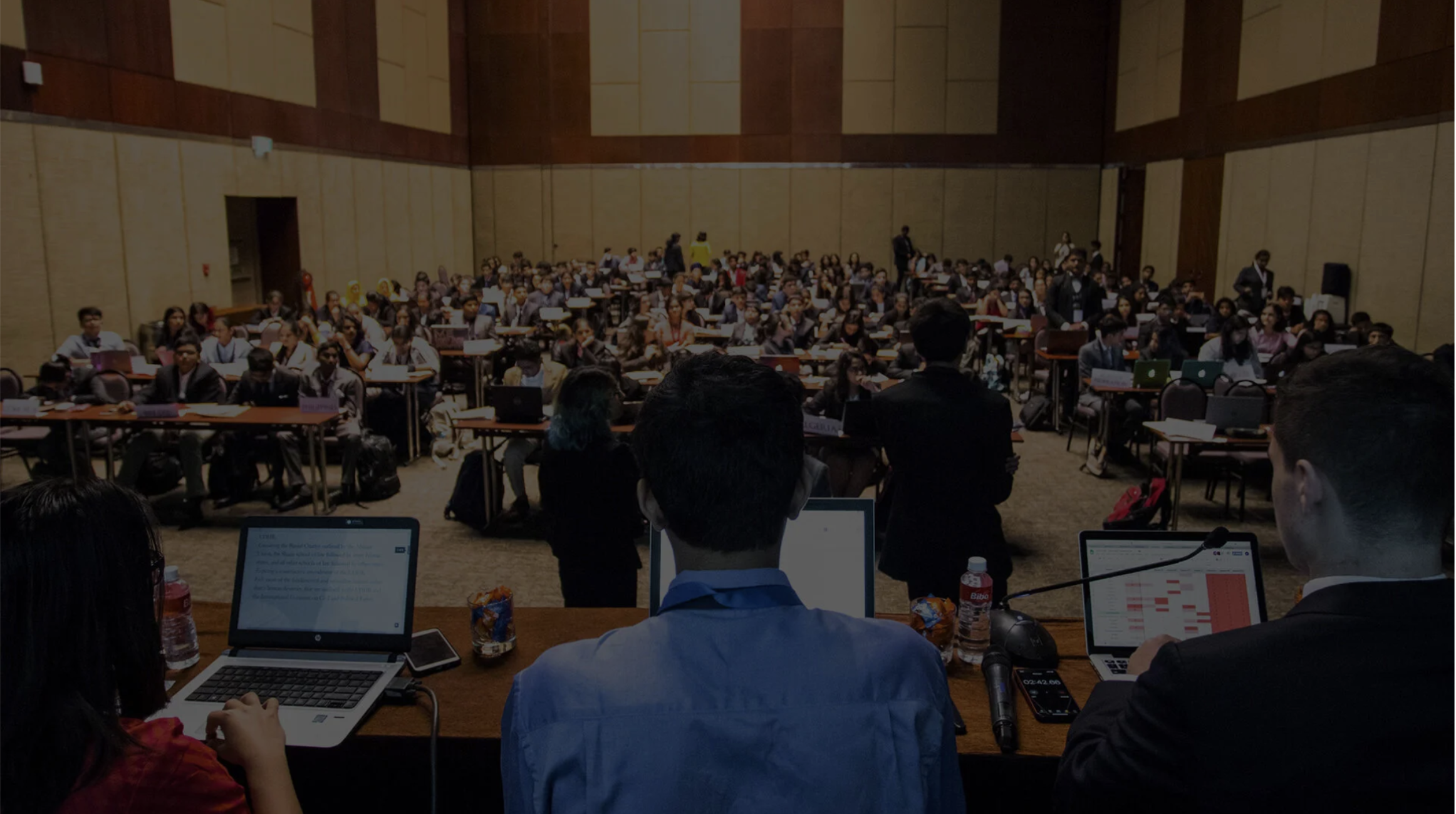
Every HMUN India committee holds four sessions over the four days of the conference for a total of nineteen hours. Committee sessions are designed to keep the delegates engaged and on their feet. The substantive aspects of the committee are coordinated by a committee director, who also serves as a moderator to guide debate according to formal rules of parliamentary procedure. The delegates usually spend the first committee session setting the agenda by deciding which topic area to discuss first. Delegates then move into a mixture of formal debates and caucuses aimed at formulating a resolution that addresses problems relating to the chosen topic area. Formal debate provides delegates with the opportunity to address the entire committee in order to clarify their positions. During the caucus, rules are suspended to allow for informal debate: delegates have the opportunity to share their ideas with other delegates so that ideas begin to coalesce outside of the constraints of parliamentary procedure. In the debate, delegates are challenged to reach a consensus within the committee while accurately representing their country’s policies.
Committee Topics and Background Guides
Every HMUN India committee director spends a significant period of time researching and compiling an extensive and comprehensive background guide. Background guides are the ideal starting point for delegating research, providing a detailed bibliography of further sources. However, additional, self-directed research is the cornerstone of the delegate experience. Delegates are encouraged and expected to conduct outside research to increase their participation in and enjoyment of the committee. Background guides are made available online to students beginning in April. When your school receives its country assignment, you will also receive a brief description of the topics being discussed by each committee.
Working Papers and Resolutions
Working papers are used to collect and circulate delegate ideas. The ideas in a working paper are debated and eventually moulded into formal documents written in the style of actual UN resolutions. After a formal introduction in committee, resolutions are debated, amended, and voted on by the body. Passed resolutions represent hours of debate, negotiation, and compromise.
While it is satisfying to see the hard work of the committee culminate in a resolution, HMUN India’s philosophy emphasises the process of negotiation rather than the resolution itself. A committee must not necessarily pass a resolution to be considered a success. HMUN India does not have official sponsors of resolutions and, in order to maximise the incentive for compromise, only one resolution on a given topic area can be passed.