
WHAT IS HMUN INDIA?
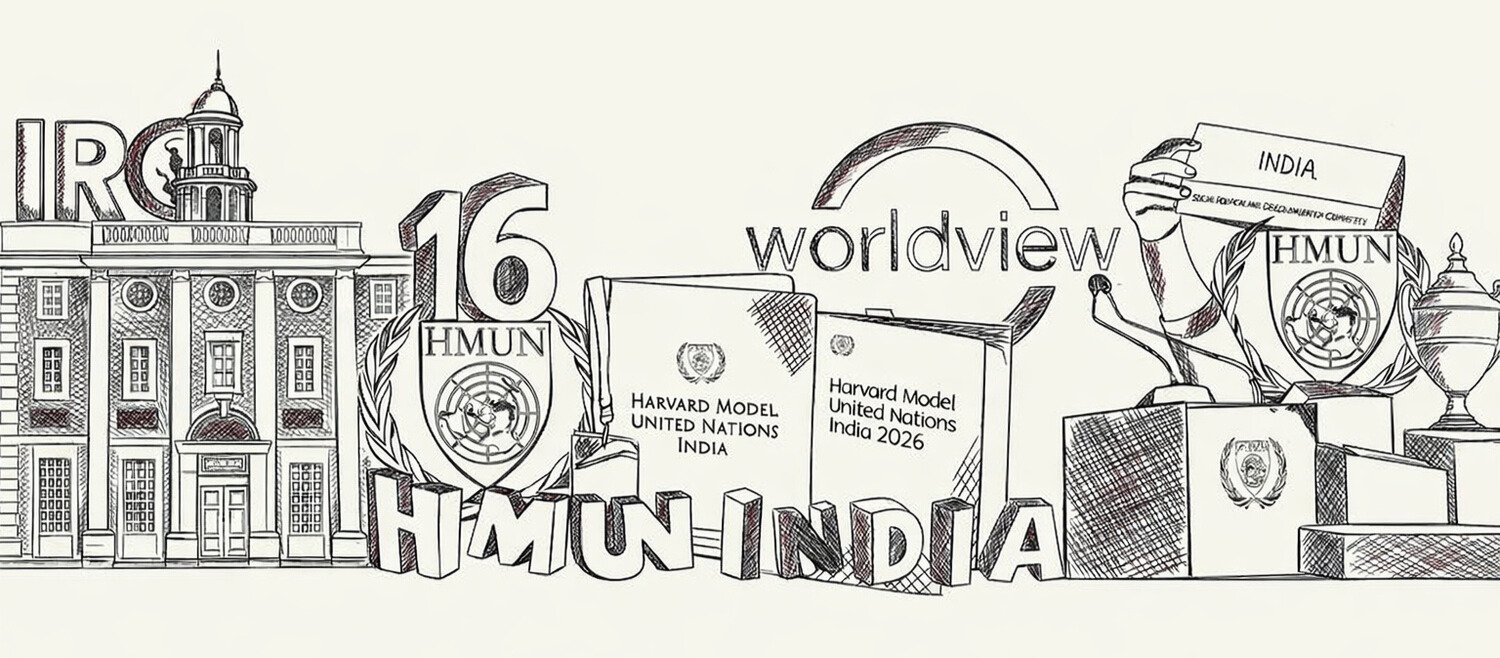
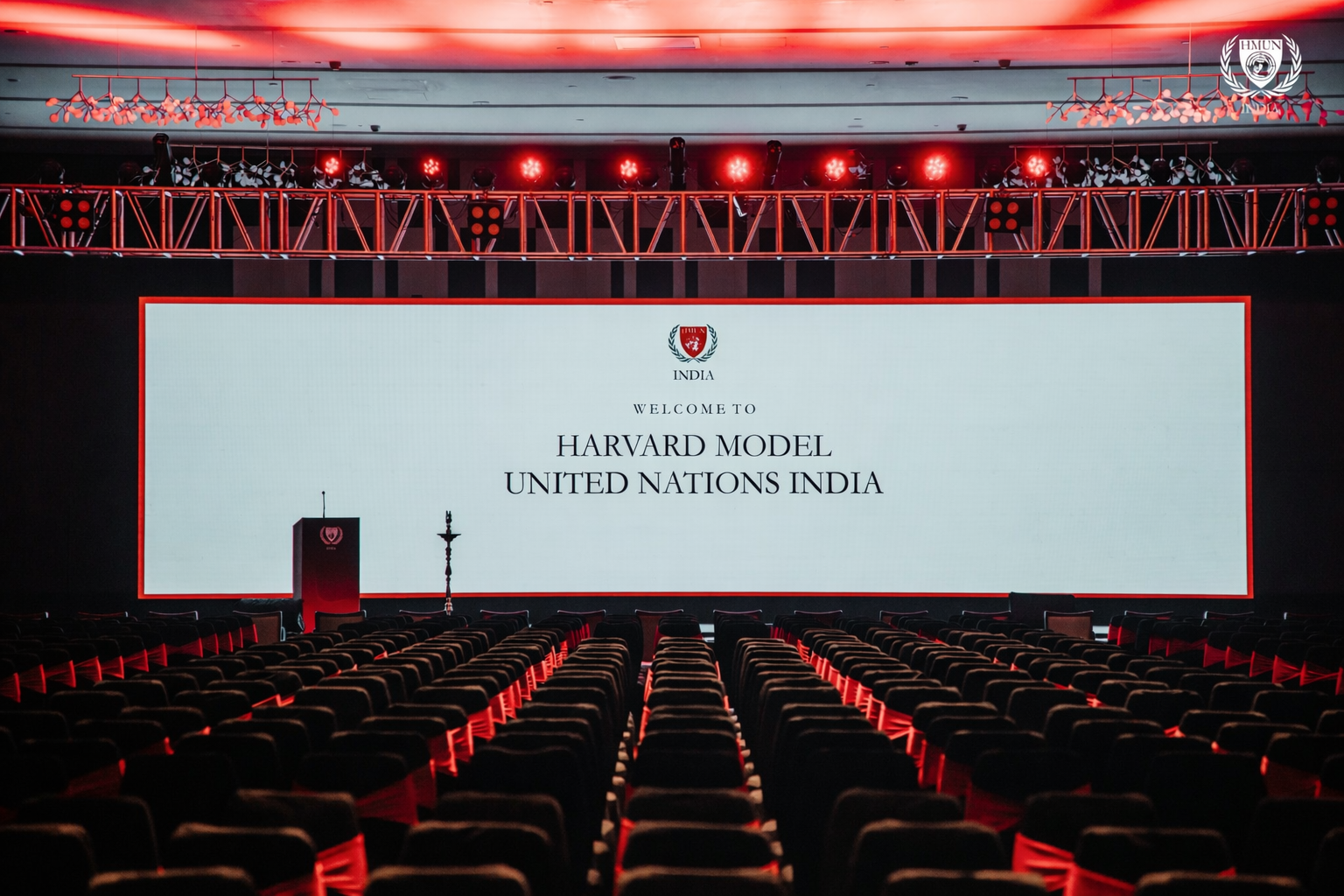
Harvard Model United Nations India is a four-day program held annually in India, bringing the academic tradition of Harvard’s Model United Nations to one of the world’s most dynamic student communities.
Rooted in an 80 year legacy of structured diplomacy simulations at Harvard University, HMUN India is designed as a serious academic environment where students engage in large scale committees that mirror real multilateral institutions. Delegates research global issues, negotiate across diverse perspectives, draft resolutions, and collaborate under formal United Nations procedures.
Chaired by undergraduates from the Harvard International Relations Council and co-produced with Worldview Education Services, the conference maintains a consistent academic standard while adapting to a rapidly changing global context. Each year, over 1,000 students from more than 300 leading schools participate, forming a peer environment defined by seriousness, ambition, and intellectual curiosity.
Beyond committee sessions, HMUN India integrates skill based workshops, curated speaker engagements, and structured college-readiness programming. Students interact directly with diplomats, policymakers, entrepreneurs, and industry leaders, gaining exposure to pathways that extend beyond school. The conference also connects dialogue to responsibility through its Impact Initiative and Development Fund, which support student-led solutions aligned with the United Nations Sustainable Development Goals.
HMUN India is not simply a conference. It is an academic experience built to test judgment, strengthen collaboration, and prepare students for global university and leadership spaces.
WHY HMUN INDIA?
Legacy and Leadership
HMUN India is the Indian chapter of Harvard Model United Nations, co-produced by Harvard International Relations Council and Worldview Education. It stands within a tradition shaped over eight decades, one that has consistently valued preparation, procedural clarity, and thoughtful engagement with global affairs.
Over time, that tradition has come to be associated with a certain standard of discourse. HMUN India continues in that spirit, placing emphasis on depth of research, disciplined debate, and respect for the process.
Scale and Diversity
Each year, over 1,000 students from more than 300 schools across India come together for four days of structured dialogue. The scale of the conference brings together a wide range of perspectives, experiences, and approaches to problem-solving.
Students engage with peers from different regions and backgrounds, learning not only to present their ideas, but to listen, reconsider, and collaborate. The diversity of the room strengthens discussion and deepens understanding of the issues being addressed.
Academic Depth and Impact
HMUN India is structured as a simulation of international diplomacy, where students represent assigned countries or portfolios, engage in negotiation, and draft resolutions under formal United Nations procedure.
Within this setting, ideas are not rushed, they are explored. Perspectives meet, shift, and refine. Conversation becomes collaboration. Students begin to see how complex questions rarely have simple answers, and how progress is shaped through dialogue.
Beyond committee sessions, leadership workshops, speaker engagements, and initiatives aligned with the United Nations Sustainable Development Goals extend the experience further. Discussion moves beyond the room. Awareness deepens. Students leave not only having debated global issues, but having understood their place within them.

“I had the opportunity to view HMUN through different perspectives and every single time it proved to be an experience that I will never forget. As a delegate back in 2016, I learnt the real meaning of diplomacy, research, and leadership. Over the years, HMUN has truly proven itself as a platform where Gen-Z gets to transform into a Generation of Solvers, all while having fun!”
- DELEGATE at HMUN INDIA 2016
Hosts


WORLDVIEW EDUCATION
Worldview is a person-centered experiential learning platform for students with an overriding focus on Transformative Leadership. We focus on what we believe is the most critical aspect of Leadership: Adaptive Capacity, the ability to adapt quickly to positively leverage the opportunities in fast changing environments. We trigger this through a variety of carefully structured experiential learning programs which necessarily engage students in working towards solutions for the challenges we face in our local & global communities. We employ a blend of experiential learning tools such as Simulations, Travel, Case-studies, Projects & Realtime work in order to create a dynamic out-of-classroom learning environment.
HARVARD INTERNATIONAL RELATIONS COUNCIL
The Harvard International Relations Council (IRC) is a 501(c)(3) non-profit founded in the 1950s and incorporated in Massachusetts in 1974. The mission of the IRC and its programs is to educate individuals at Harvard and across the world about affairs that transcend national borders. The IRC is an umbrella organization for seven semi-independent and centrally-funded programs: Harvard Project for International Education, International Relations on Campus, Harvard International Review, Model Security Council, Intercollegiate Model United Nations, Harvard Model United Nations, and Harvard National Model United Nations. Run entirely by undergraduates at Harvard University, the International Relations Council strives to inspire and impact individuals worldwide.